
Halo Infinite Career Ranks Guide: Full Ranking System Explained
You load into matchmaking, finish a solid game with 25 kills and multiple objective captures, then notice your progression bar barely moved. That confusion is exactly why so many players search for Halo Infinite ranks, career XP, and an explanation of how the entire progression ladder actually works.
Here’s the thing most guides fail to explain clearly: the modern Halo Infinite ranking structure is split into two completely different systems. One tracks your long-term grind—the other tracks competitive skill.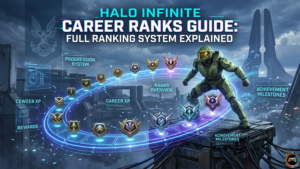
Quick Answer
The Halo Infinite ranks system includes two progression paths: Career Rank and Competitive Skill Rank (CSR). Career Rank is a permanent progression ladder tied to cumulative Personal Score earned in multiplayer matches, while CSR measures skill performance in Ranked Arena playlists. Reaching Hero Rank requires millions of XP and hundreds of hours of multiplayer activity, especially for casual players.
What Are Career Ranks in Halo Infinite?
Career progression finally gave Halo Infinite the long-term grind many players expected at launch. Before that update, multiplayer progression felt disconnected. You earned battle pass XP, but there was no true military-style progression system similar to older Halo games like Halo: Reach.
Now, your overall account progression reflects almost every completed multiplayer match you play.
Why Career Ranks Were Added to Halo Infinite
343 Industries added Career Ranks during Season 4: Infection, after years of community feedback. Players wanted a persistent progression framework that rewarded gameplay investment even outside ranked playlists.
Older titles such as Halo: Reach and Halo 3 had iconic progression ladders that made leveling feel meaningful. Halo Infinite originally lacked that long-term player advancement loop.
Career Ranks solved that retention problem by creating a visible progression journey tied directly to gameplay performance.
You now get rank visibility in your Spartan profile, match intro banner, post-game carnage report, and player inspection screens.
How the Career Rank System Works
Unlike battle pass levels, Career Rank progression never resets between seasons.
Your advancement comes from the Personal Score earned during multiplayer activity. Every kill, assist, objective capture, medal, and completed match contributes toward your cumulative progression.
Think of it as a permanent military rank ladder:
| Rank Tier | Progression Structure |
| Bronze | Entry progression |
| Silver | Early advancement |
| Gold | Mid progression |
| Platinum | Skilled player tiers |
| Diamond | High engagement ranks |
| Onyx | Elite progression |
| Hero | Final prestige tier |
Each tier contains six grades, creating a very long progression path.
Difference Between Career Rank and Competitive Rank
This is where many beginners get confused.
Career Rank measures time and score accumulation. CSR measures actual competitive skill.
Your Career Rank increases even in casual playlists like Husky Raid or Firefight. Meanwhile, CSR only changes inside Ranked Arena matchmaking matches.
A player can technically reach Hero Rank while remaining average in competitive playlists.
What Progress Carries Across Seasons?
Almost everything.
Your Career Rank, progression milestones, overall account progression, and rank showcase remain permanent. Seasonal battle passes may expire or rotate, but Career Rank progression persists indefinitely.
That permanence is why many players now treat Career Rank as the “real” Halo progression system.
Halo Infinite Career Ranks Explained
The full Halo Infinite rankings ladder contains multiple military-inspired tiers that mirror classic Halo progression systems.
Bronze Ranks (Bronze I to VI)
Bronze serves as the onboarding phase for new players.
You move through these levels quickly because XP requirements stay relatively low. Most players leave Bronze within a few hours of consistent matchmaking.
Silver Ranks (Silver I to VI)
Silver introduces slower progression pacing.
At this point, the progression tracking system expects more consistent multiplayer engagement and better scoring efficiency.
Gold Ranks (Gold I to VI)
Gold represents the average active player population.
Many casual players spend dozens of hours inside Gold because XP requirements ramp up aggressively after early progression tiers.
Platinum Ranks (Platinum I to VI)
Platinum is where the grind becomes noticeable.
In my experience, this is also where players begin optimizing score per hour instead of simply playing casually.
Diamond Ranks (Diamond I to VI)
Diamond progression requires serious gameplay investment.
Matches become less about winning and more about maximizing Personal Score generation through objective efficiency.
Onyx Ranks (Onyx I to VI)
Onyx acts as the elite endgame grind before Hero Rank.
XP requirements spike dramatically here. Some players report needing hundreds of matches for a single advancement grade.
Hero Rank (The Final Career Rank)
Hero Rank is the highest Career Rank available in the current Halo Infinite rank system.
Reaching Hero status unlocks one of the most recognizable customization rewards in multiplayer. Many longtime fans specifically grind Hero for the nostalgic Master Chief-inspired cosmetic reward.
Only a small percentage of the player base has reached Hero Rank due to the enormous XP requirement.
Complete Career Rank Table with XP Requirements
| Tier | Estimated XP Range |
| Bronze | 0 to 150,000 |
| Silver | 150,000 to 500,000 |
| Gold | 500,000 to 1.2 million |
| Platinum | 1.2 million to 2.4 million |
| Diamond | 2.4 million to 4 million |
| Onyx | 4 million to 9 million |
| Hero | 9 million+ |
Exact progression values can shift slightly after updates and balancing patches.
How Career Rank XP Works
Understanding score generation matters more than raw wins.
What Actions Grant Career XP?
Career XP comes primarily from Personal Score earned during matches.
You gain score through:
- Kills
- Assists
- Objective captures
- Flag returns
- Zone control
- Vehicle usage
- Medal chains
- Match completion
Match Completion XP Explained
Leaving early destroys progression efficiency.
Halo Infinite rewards completed matches heavily because the system prioritizes multiplayer engagement and consistent participation.
Players who quit frequently slow their advancement path dramatically.
Performance-Based XP Factors
Strong individual performance matters.
A high-scoring loss often grants better progression than a low-impact victory. That design encourages active gameplay instead of passive farming.
Here’s what most guides miss: objective medals generate far more progression value than many players realize.
Imagine playing Strongholds. One player farms kills away from zones while another captures and defends objectives repeatedly. The objective-focused player often earns better overall progression milestones despite fewer eliminations.
Does Winning Increase Career Rank Progress?
Indirectly, yes.
Wins usually create longer matches with more opportunities for kills, assists, and objective scoring. Still, the system rewards Personal Score more than pure win rate.
XP Multipliers and Special Events
Double XP Boosts mainly affect battle pass progression rather than Career Rank progression.
Special events, however, sometimes increase overall match XP efficiency through bonus playlists and score-focused modes.
That distinction confuses many new players grinding Halo Infinite’s ranked playlists.
Fastest Ways to Level Up Career Rank
Most players grind inefficiently without realizing it.
Play Objective-Based Game Modes
Objective modes consistently generate higher Personal Score totals than Slayer-focused playlists.
Oddball, Total Control, and Strongholds often outperform simple Team Slayer for rank progression.
Focus on High Score Matches
Efficiency matters more than match count.
A 3,000-point game provides dramatically better advancement than two low-scoring matches combined.
Stay Active Until Match End
AFK behavior tanks progression.
The matchmaking progression system rewards constant contribution across the entire game duration.
Complete Matches Efficiently
Fast matches with high score output provide the best XP per hour ratio.
That’s why Husky Raid became one of the most popular grinding playlists.
Best Team Strategies for Consistent XP
Squad play creates a more stable progression than solo queue.
Coordinated teams maintain objective pressure better, leading to higher cumulative progression scores and more consistent advancement rewards.
Common XP Farming Myths to Avoid
One myth still circulates constantly:
“Only kills matter.”
That simply is not true. Objective medals, assists, and support play contribute heavily toward the performance scoring system.
Best Game Modes for Career Rank Progression
Different playlists reward progression differently.
Big Team Battle
Big Team Battle produces chaotic, high-scoring matches with vehicles and extended engagements.
Excellent for casual grinders.
Firefight
Firefight became one of the strongest progression modes after balancing updates.
PvE encounters allow consistent medal farming with relatively low stress.
Husky Raid
Husky Raid offers absurd score potential.
Short matches combined with constant combat make it one of the best XP per hour playlists in the game.
Quick Play
Quick Play works well for beginners learning Halo Infinite career ranks without intense matchmaking pressure.
Ranked Arena
Ranked Arena improves your CSR but usually provides slower Career Rank progression compared to objective-heavy casual playlists.
Which Mode Provides the Best XP Per Hour?
| Mode | XP Efficiency | Difficulty |
| Husky Raid | Very High | Moderate |
| Firefight | High | Easy |
| Big Team Battle | High | Casual |
| Ranked Arena | Medium | Hard |
| Quick Play | Medium | Easy |
Firefight currently provides the best balance between consistency, low stress, and reliable progression speed.
Career Rank Rewards and Unlockables
Progression feels better when rewards actually matter.
What Rewards Are Available?
Players unlock:
- Armor emblems
- Weapon emblems
- Vehicle emblems
- Nameplates
- Spartan profile customization
- Rank badges
Armor Coatings and Cosmetic Unlocks
Many cosmetics remain purely prestige-based.
That exclusivity gives Hero Rank genuine recognition value across multiplayer matchmaking.
Hero Rank Reward Breakdown
The Hero reward remains one of the most respected unlocks in Halo Infinite.
You instantly stand out during match introductions and player inspection.
Are Career Rank Rewards Worth the Grind?
For competitive players, probably yes.
For casual users, the answer depends on whether you enjoy persistent progression systems and long-term achievement recognition.
Upcoming Reward Possibilities
343 Industries continues expanding seasonal content and progression rewards.
Additional cosmetics tied to cumulative progression seem likely in future updates.
Career Rank vs Competitive Skill Rank (CSR)
These systems overlap, but they measure completely different things.
What Is Competitive Skill Rank?
CSR stands for Competitive Skill Rank.
This ranking determines matchmaking opponents in Ranked Arena playlists.
Typical CSR tiers include:
- Bronze
- Silver
- Gold
- Platinum
- Diamond
- Onyx
Veteran players often compare this structure to the older Halo 3 ranking and Halo Reach ranking system models.
How CSR Progression Works
CSR changes based on:
- Match outcome
- Opponent skill level
- Individual performance
- Consistency
Unlike Career Rank, CSR can decrease after losses.
Key Differences Between CSR and Career Rank
| Career Rank | CSR |
| Permanent progression | Skill based |
| Never resets easily | Seasonal adjustments |
| Score accumulation | Competitive performance |
| Casual playlists count | Ranked only |
Which System Reflects Player Skill?
CSR reflects pure skill far more accurately.
Career Rank reflects dedication and multiplayer activity.
Can You Progress Both at the Same Time?
Absolutely.
Many players grind Career Rank while improving their skill rating and Halo Infinite performance simultaneously.
How Long Does It Take to Reach Hero Rank?
This is the question everyone eventually asks.
Total XP Needed for Hero Rank
Reaching Hero requires roughly 9 million Career XP.
That number alone explains why Hero status remains rare.
Estimated Hours for Casual Players
Casual players averaging lower scores in matches may need 1,500 to 2,000 hours.
Estimated Hours for Regular Players
Consistent, objective-focused players often finish between 900 and 1,300 hours.
Estimated Hours for Hardcore Players
Highly optimized grinders using Firefight and Husky Raid strategies can reach Hero substantially faster.
Factors That Affect Progress Speed
Big variables include:
- Playlist selection
- Match efficiency
- Objective participation
- Squad coordination
- Quit frequency
Career Rank Tips and Mistakes to Avoid
Small mistakes add hundreds of wasted hours over time.
Prioritize Score Producing Objectives
Flags, zones, assists, and support medals matter enormously.
Avoid Leaving Matches Early
Early quits destroy progression efficiency and reduce multiplayer engagement rewards.
Choose XP Efficient Playlists
Firefight and Husky Raid currently dominate efficient progression tracking.
Track Progress Consistently
Checking your progression milestones helps maintain motivation during long grinds.
Mistakes That Slow Down Ranking
Common errors include:
- Ignoring objectives
- AFK farming
- Constant playlist switching
- Chasing kills only
- Solo queue frustration spirals
Is the Career Rank System Worth Grinding?
Honestly, yes for most long-term Halo fans.
Benefits of Long-Term Progression
Persistent progression gives multiplayer purpose outside pure competition.
Older Halo games thrived because players always had another advancement goal waiting.
How Career Ranks Improve Player Retention
Visible progression status keeps players engaged even during rough matchmaking sessions.
Pros and Cons of the System
| Pros | Cons |
| Permanent progression | Extremely long grind |
| Strong prestige factor | Limited gameplay rewards |
| Better player recognition | Can feel repetitive |
| Encourages consistent play | Hero takes a massive time |
Who Should Focus on Career Rank Progression?
Players who enjoy steady progression ladders, military rank insignia systems, and long-term multiplayer accomplishment tracking will get the most value from it.
Frequently Asked Questions About Halo Infinite Career Ranks
What is the highest Career Rank in Halo Infinite?
Hero Rank is currently the maximum rank in the Career progression system.
How do you earn Career Rank XP?
You earn XP through Personal Score generated during multiplayer matches, including kills, objectives, assists, and completed games.
Does Ranked Arena affect Career Rank progression?
Yes. Ranked matches still contribute Career XP while also affecting CSR progression.
Can Career Ranks be reset?
No. Career progression is designed as a persistent ranking system.
How much XP is required to reach Hero Rank?
Players need roughly 9 million cumulative XP.
Which game mode gives the most Career Rank XP?
Firefight and Husky Raid currently provide the strongest XP efficiency for most players.
Final Thoughts on Halo Infinite Career Ranks
The modern Halo Infinite ranks system finally gives Halo Infinite the persistent progression framework players wanted at launch. Career Rank rewards consistency, objective play, and long-term multiplayer engagement rather than pure win streaks alone.
If your goal is reaching Hero Rank faster, focus on efficient score generation instead of obsessing over kills. Firefight, Husky Raid, and objective modes consistently outperform traditional slayer playlists for progression speed.
Future updates will probably expand rewards, progression categories, and rank showcase customization even further. Until then, the smartest approach is simple: play efficiently, finish matches, and prioritize Personal Score every single game.