
Clair Obscur: Expedition 33 — How Long Is It & Everything You Need to Know
Quick Answer: Clair Obscur: Expedition 33 takes roughly 29 to 30 hours to complete the main story, around 46 hours with side content, and up to 67 hours for full 100% completion. Your actual time depends heavily on playstyle, difficulty settings, and how much of the hand-painted world you want to explore.
Most RPGs either overstay their welcome or leave you wanting more. Expedition 33 somehow threads that needle perfectly — and that’s exactly why PC gamers and RPG fans can’t stop talking about it.
Whether you just bought it, you’re halfway through Act 2, or you’re trying to figure out if it’s worth your weekend, this guide has the real answers. Not vague estimates. Actual numbers, honest takes, and practical tips built for both casual players and completionists alike.
1. What Is Clair Obscur: Expedition 33?
The Story Premise and Setting
Picture a world where every year, a mysterious figure known as the Paintress writes a number on her monolith — and everyone that age simply ceases to exist. Right now, she’s written 33. That means every member of Expedition 33, including your protagonist Gustave and his companions, is living on borrowed time.
It’s a haunting premise. Dark, emotional, and surprisingly personal once the story gets going. The game takes place across beautifully painted landscapes — think watercolor skies, surreal architecture, and environments that feel like walking through a living painting. Lumiere serves as your home base, and from there, the world opens up in ways that continue to surprise.
What Makes It Different From Other RPGs?
Here’s what most guides miss: Expedition 33 isn’t just a turn-based RPG with a pretty coat of paint. The combat blends classic turn-based strategy with real-time dodging and parrying. You’re not just selecting actions and watching animations play out — you’re actively timing button presses to block incoming attacks or land perfect counters. Miss the timing, and you take full damage. Nail it, and you gain combat advantages that can flip a tough fight entirely.
That hybrid system is what keeps combat from ever feeling stale, even 40 hours in.
Who Developed It and When Was It Released?
Sandfall Interactive, an independent French studio, developed the game. It launched on PC via Steam in April 2025 and immediately earned a reputation as one of the most ambitious debut titles from an indie studio in years. The team reportedly kept the scope intentional — they wanted an intense, focused experience rather than a sprawling open world.
Is It Worth Playing? Quick Verdict
Yes. Without hesitation. If you enjoy story-driven RPGs with real combat depth, Expedition 33 delivers one of the most emotionally resonant experiences in recent memory. The painted world alone is worth the price of admission.
2. How Long Is Clair Obscur: Expedition 33?
This is the section most people are actually here for, so let’s be direct.
How Long to Beat the Main Story?
The main story runs approximately 29 to 30 hours. That figure comes from real player data logged on HowLongToBeat, which now has thousands of submissions. It lines up almost exactly with what Sandfall Interactive said before launch — a focused playthrough targeting around 30 hours.
Speed-runners who skip dialogue and stay on the critical path tend to finish in 25 to 27 hours. Players who stop for cutscenes, replay tough boss fights, or simply take in the scenery regularly clock 32 to 35 hours. If you fall somewhere in the middle, expect a clean 28 to 30-hour main story experience.
How Long to 100% Complete the Game?
Going for full 100% completion? Budget around 67 hours, with the median sitting close to 66 hours based on nearly two thousand completionist reports on HowLongToBeat. Sandfall Interactive estimated around 60 hours for a complete run, and that’s realistic if you’re efficient.
Here’s what pushes the clock past 60 hours:
- Hunting all 33 music records scattered across every region
- Clearing every optional boss encounter
- Completing no-damage runs and unique ability feats for specific characters
- Collecting every journal entry across the maps
- Achievement grinding for the toughest in-game challenges
None of it feels like padding. That’s genuinely rare in this genre.
Is 30 to 60 Hours Too Long or Just Right?
Honestly? It’s almost ideal. Modern RPGs often bloat their runtimes with repetitive side quests and empty open zones. Expedition 33 keeps its linear gameplay tight while giving explorers enough optional content to double their playtime meaningfully. The devs made a deliberate choice to keep things “intense and short” in their words, and it paid off.
How Expedition 33 Compares in Length to Similar RPGs
| Game | Main Story | With Extras | 100% |
| Clair Obscur: Expedition 33 | ~30 hrs | ~46 hrs | ~67 hrs |
| Octopath Traveler 2 | ~55 hrs | ~70 hrs | ~90 hrs |
| Final Fantasy XVI | ~35 hrs | ~55 hrs | ~75 hrs |
| Persona 5 Royal | ~101 hrs | ~120 hrs | ~143 hrs |
| Sea of Stars | ~25 hrs | ~35 hrs | ~45 hrs |
Expedition 33 slots perfectly for players who want a complete, satisfying adventure without a 100-hour commitment.
3. Game Structure — How Many Acts Are There?
Act 1 Overview — What to Expect
Act 1 serves as your introduction to the world, the combat system, and the emotional core of the story. You move through Lumiere’s rooftops and harbour, then out into the Meadows Corridor and Grand Meadow. It’s deliberately paced — slower, atmospheric, and focused on building attachment to the characters before things escalate.
Act 2 Overview — Where the Story Deepens
Act 2 is where Expedition 33 fully opens up. More regions, more optional content, harder bosses, and story revelations that genuinely reframe everything you experienced in Act 1. The Flying Waters, Gestral Village, Sanctuary Maze, and Coral Cave all unlock here. Expect this act to take the longest if you’re doing any side content exploration.
Act 3 Overview — The Final Push and Endings
Act 3 tightens the pacing significantly. It’s emotionally relentless, moving through Old Lumiere, the Monolith, and Tainted Zones — areas that feel fundamentally different from everything that came before. This is where the race to stop the Paintress reaches its climax.
How the Acts Are Connected Narratively
Each act builds directly on the previous one thematically and narratively. Choices and character moments from Act 1 pay off in Act 3 in ways that feel earned rather than forced. The short prologue and epilogue structure bookends the experience cleanly.
Are There Multiple Endings? (Spoiler Free)
Yes — two distinct endings exist, and both are accessible in a single playthrough. Unlocking both requires completing specific late-game content in Act 3. No second playthrough needed, which is a genuinely player-friendly design choice that most guides bury at the bottom of their FAQs.
4. Full Walkthrough — Act 1 (Beginner’s Path)
Rooftops and Flower Market — Getting Started
Act 1 opens in Lumiere with a short prologue that establishes the world’s rules quickly. The Rooftops section introduces basic movement and exploration mechanics. Don’t rush past the Flower Market — there’s a journal entry here that many players miss on their first run, and it adds meaningful context to a late-game reveal.
Harbour — Key Events and Collectibles
The Harbour marks your first real encounter with the outside world. Pick up every glowing item you see here — several are missable and don’t respawn. This area also contains your first look at optional boss encounters, though tackling them immediately is likely going to get you wiped at the current level.
Meeting Lune — Story Choices That Matter
Meeting Lune is one of Act 1’s defining moments. Dialogue choices here don’t alter the main story ending, but they do affect certain character interactions later. Pay attention — it’s easy to rush this sequence and miss the emotional weight of what’s being set up.
Grand Meadow and Meadows Corridor — Exploration Tips
These open zones are your first taste of non-linear exploration. Use your in-game map markers obsessively here. The Meadows Corridor especially branches in ways that feel confusing on a first playthrough — mark anything you can’t access yet and come back after leveling up.
The Indigo Tree — First Major Milestone
Reaching the Indigo Tree signals the end of Act 1’s main path. This area has the first genuinely challenging story boss. If you’ve been avoiding combat, you’ll feel it here. Take the time to understand the real-time dodging mechanic fully before this fight — it becomes essential from here forward.
5. Full Walkthrough — Act 2 (Mid-Game Exploration)
Flying Waters and The Manor — Navigation Guide
The Flying Waters introduce verticality to exploration in a way that Act 1 never does. The Manor connected to this area is easy to walk past entirely — it contains Noco, a character whose questline rewards one of the game’s better mid-game abilities. Worth every minute spent.
Coral Cave and Lumièran Streets — Hidden Secrets
Coral Cave has the highest density of scattered collectibles in Act 2. Go slowly. Lumièran Streets, by contrast, moves quickly but hides two optional journal entries behind what look like dead-end paths. They’re not dead ends — they just require a specific traversal ability unlocked shortly before this area.
Gestral Village and Expedition Camp — Side Content Worth Doing
In my experience, players who skip Gestral Village regret it around hour 50. The side content here feeds directly into one of the more emotionally satisfying optional storylines in the game. It never feels like a grind — more like discovering a whole subplot the main path doesn’t acknowledge.
Sanctuary Maze and Giant Bell Alley — Puzzle Tips
The Sanctuary Maze is the one area where backtracking actually works against you if you’re not methodical. Draw it out mentally or use screenshots. Giant Bell Alley has a timing-based puzzle that stumps a lot of players — the answer involves the combat speed mechanics you’ve been building all game.
Area Bosses — How to Prepare and Win
Optional bosses in Act 2 hit significantly harder than story bosses at the same point. Don’t engage them under-leveled out of curiosity. Check your Lumina Points distribution before each fight and make sure Maelle’s build matches the boss’s resistances.
6. Full Walkthrough — Act 3 and Endgame (Advanced Players)
Old Lumière and Shattered Alley — Final Story Areas
Old Lumière is visually stunning and narratively brutal. Shattered Alley connects several story threads from Acts 1 and 2 in ways that hit harder if you did the side content. First-time players often comment that this section made them stop and sit with the story for a moment. That reaction is entirely intentional.
The Monolith — What It Is and How to Enter
The Monolith is Expedition 33’s endgame dungeon structure. Entering it requires completing a specific sequence in Act 3 that isn’t telegraphed clearly. Look for the conversation trigger at the Expedition Camp before heading to the Continent — skipping it locks you out of optional content inside.
Tainted Zones — Full Breakdown (Meadows to Lumière)
The Tainted Zones are Act 3’s most demanding areas. Nine distinct sub-zones from Tainted Meadows through to Tainted Lumière, each with escalating enemy difficulty. The Tainted Battlefield contains one of the game’s most memorable optional encounters — challenging but entirely worth it.
Renoir’s Drafts and The Abyss — Late Game Secrets
Renoir’s Drafts hides behind a questline that starts much earlier in the game. If you completed the relevant steps in Acts 1 and 2, this area opens naturally. If not, it stays locked. The Abyss connects to the final story boss in ways that only become clear in the closing hour of the game.
How to Unlock Both Endings
Both endings require completing the Opera House sequence in Lumière before triggering the final story event. Don’t advance the main quest past a specific point without first returning to the Opera House — the game doesn’t warn you explicitly, and the window closes permanently.
7. Character Skills and Combat System Explained
Monoco’s Skills — Best Builds and Unlock Order
Monoco functions as a support-damage hybrid. Prioritize unlocking the skills that extend turn duration first — they compound significantly as the game progresses. His mid-tier abilities unlock through specific Pictos rather than level milestones, so check your Pictos collection regularly.
Maelle’s Final Stage Skills — What Changes and Why It Matters
Maelle’s final stage skills fundamentally shift her combat role from damage dealer to a character capable of altering the flow of entire encounters. These unlock in Act 3 and require specific Lumina Points investment to use effectively. Players who don’t build toward this miss one of the game’s most satisfying combat transitions.
Understanding Lumina Points — How to Distribute Them
Lumina Points are earned through Colours of Lumina and distributed freely across your party. The system rewards intentional builds over passive level-up bonuses. Early game, focus on survivability. Mid-game, shift toward ability synergies. Late game, optimize around boss-specific matchups.
Unlocking Luminas Through Pictos — Step by Step
- Collect Pictos from exploration and boss drops
- Equip Pictos in your character’s dedicated slots
- Hold Pictos long enough to permanently unlock their associated Lumina
- Unequip the Picto and reallocate it — the Lumina stays unlocked
This system lets you recycle Pictos efficiently rather than hoarding them, which most beginner players don’t realize until well into Act 2.
Beginner Combat Tips to Master Early
Real-time dodging has a forgiving window that shrinks on higher difficulties. Learn the audio cues for incoming attacks — they’re more reliable than visual tells for the faster enemies. And never save your best abilities for “the right moment.” Use them because the combat speed of Expedition 33 rewards aggression over caution.
8. Exploration Guide — Key Locations and Hidden Areas
The Continent — How to Navigate Efficiently
The Continent serves as the connective tissue between major zones. It looks sparse at first. It isn’t. Hidden paths, optional encounters, and collectibles cluster in areas that look like decoration rather than gameplay space. Slow down whenever you see unusual color patterns in the environment — the color coding system is actually a navigation tool.
Hidden Gestral Arenas — Locations and Rewards
Three hidden arenas exist across the Gestral areas. Each offers unique enemy matchups and rewards that don’t appear anywhere else. Finding them requires completing specific Gestral NPC questlines rather than pure exploration — another reason the side content in this game actually matters.
Flying Casino and Painting Workshop — Are They Worth It?
Yes to both, for different reasons. The Flying Casino contains one of the better loot opportunities in mid-to-late game. The Painting Workshop feeds directly into character-specific questlines. Neither is required, but skipping both leaves noticeable gaps in the overall experience.
Frozen Hearts and Glacial Falls — Full Area Breakdown
Frozen Hearts splits into six distinct sub-areas, including the Icebound Train Station, two sections of Glacial Falls, and the Iced Heart at the center. This is one of the game’s longest optional dungeon sequences and also one of the most visually inventive. Budget two to three hours here if you’re being thorough.
Color Coding System — What It Means for Exploration
Expedition 33 uses a subtle color language to signal interactable objects, hidden paths, and danger levels without cluttering the screen with UI markers. Warm colors generally indicate collectibles or story items. Cool blues mark environmental puzzles. Once you internalize this, navigation becomes significantly faster.
9. Side Content, Collectibles, and 100% Completion Tips
What Does 100% Completion Require?
Full completion demands all 33 music records, every journal entry, all optional boss clears, both endings unlocked, and completion of major character challenge milestones. The music records are the most commonly missed item — several are tied to time-sensitive moments in the story rather than open exploration.
Missable Content — What Not to Skip
Before advancing past Act 1’s Harbour sequence, grab the journal behind the eastern dock. Before leaving Act 2’s Gestral Village, complete the full NPC chain. Before triggering the final Act 3 event: return to the Opera House. Those three moments cover the majority of permanently missable content.
Gestral Beach and Hidden Arenas — Optional But Rewarding
Gestral Beach opens late in the game and contains two questlines that pay off earlier character moments in genuinely moving ways. The Hidden Gestral Arena attached to this area has the greatest difficulty optional encounter in the base game — bring your best build.
Chromatic Petank and Mini-Games — Are They Worth Your Time?
Chromatic Petank is Expedition 33’s in-world mini-game. It’s charming, surprisingly deep, and rewards dedicated players with unique cosmetic items. If you enjoy mini-games, it’s worth 30 to 60 minutes of your time. If you’re purely focused on completion, it’s skippable — the rewards don’t affect combat.
Best Order to Tackle Side Quests
Do Gestral Village quests during Act 2 naturally. Save the Painting Workshop and Flying Casino for late Act 2 or early Act 3. Leave the Hidden Arenas until you have fully developed character builds. Rushing the arenas under-leveled just burns hours retrying fights you’re not ready for.
10. Tips, Tricks, and Common Mistakes to Avoid
Best Early Game Decisions That Save You Later
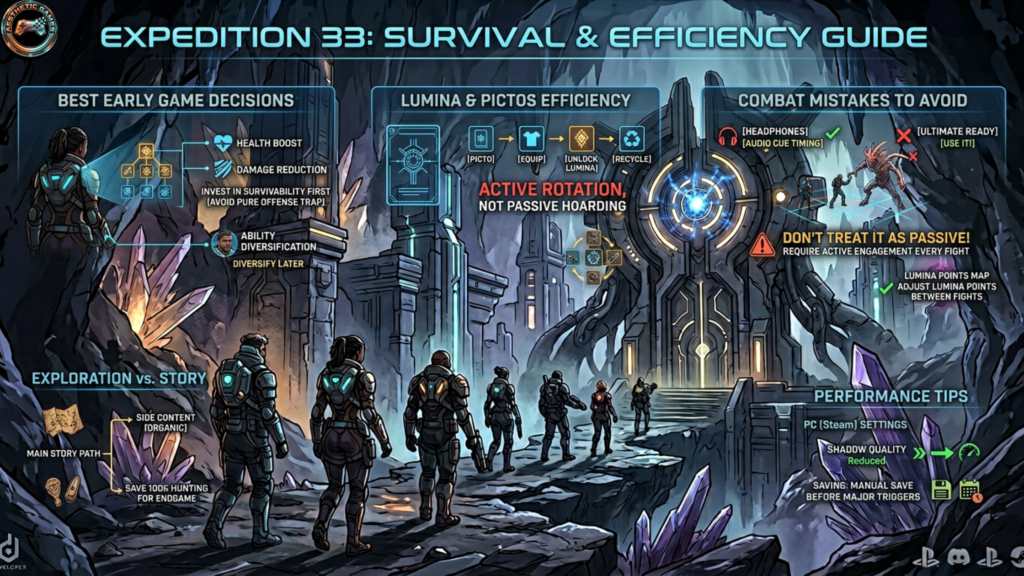
Invest in survivability first. New players consistently make the mistake of building pure offense and hitting a wall at the Act 1 final boss. Spend your earliest Lumina Points on health and damage reduction before diversifying into ability upgrades.
How to Manage the Lumina and Pictos System Efficiently
Never hoard Pictos waiting for a perfect moment. Equip them, unlock the associated Luminas, then recycle. The system is designed for active rotation, not passive collection. Players who understood this early had noticeably smoother mid-game experiences than those who didn’t.
Combat Mistakes Most New Players Make
Ignoring audio cues for the real-time dodge timing. Saving ultimate abilities for boss fights and then forgetting to use them. Not adjusting Lumina Points distribution between major encounters. The single biggest mistake is treating Expedition 33 like a passive turn-based game — the real-time elements require active engagement every single fight.
Should You Follow the Story or Explore First?
Follow the story on your first playthrough, but detour into side content whenever it presents itself naturally. Don’t backtrack aggressively. The game is designed so that organic exploration during the main path covers most of the best content anyway. Save systematic 100% hunting for a second pass or the endgame phase.
Performance Tips — Lag, Saves, and Settings
On PC via Steam, Expedition 33 runs well on mid-range hardware. If you’re experiencing lag during large-scale boss fights, reducing shadow quality gives the best performance return without noticeably impacting the visual experience. Save manually before every major story trigger — the auto-save system works well, but manual saves before big moments protect against frustrating reruns.
FAQ — Clair Obscur: Expedition 33
How many hours does it take to beat Clair Obscur: Expedition 33? The main story takes around 29 to 30 hours. With side content exploration added, expect roughly 46 hours. Full 100% completion averages 67 hours based on HowLongToBeat data from thousands of players.
How many acts are in Clair Obscur: Expedition 33? Three main acts plus a short prologue and epilogue. Act 2 is the longest by a significant margin, especially if you engage with optional content.
Does Clair Obscur: Expedition 33 have multiple endings? Yes, two endings exist, and both are accessible in a single playthrough by completing the Opera House sequence before the final story event triggers.
Is Clair Obscur: Expedition 33 good for beginners? Yes, with one caveat. The real-time dodging mechanic requires active attention and doesn’t suit completely passive players. The difficulty settings are flexible enough that beginners can lower them on specific encounters without penalty.
What is the hardest area in Clair Obscur: Expedition 33? The Tainted Zones in Act 3 are the most demanding for main story content. For optional content, the Hidden Gestral Arena near Gestral Beach features the game’s toughest encounter.
Can you miss side quests or collectibles permanently? Yes. Several journal entries and at least one music record are tied to specific story windows. The most commonly missed content is in the Harbour sequence at the end of Act 1 and the Opera House trigger before the Act 3 finale.
What is the Lumina Points system, and how does it work? Lumina Points are earned through Colours of Lumina and distributed freely across your party to enhance abilities and stats. Luminas themselves are unlocked by equipping and holding specific Pictos long enough to permanently absorb their bonuses.
Is Clair Obscur: Expedition 33 worth the full price? Absolutely. For a 30 to 67-hour RPG experience with genuine combat depth, an emotionally resonant story, and a world that feels unlike anything else in the genre right now, it represents real value regardless of how deep you choose to go.
No matter how you approach it, Expedition 33 rewards the time you put in. A focused 30-hour main story run feels complete and satisfying. Pushing toward 100% completion uncovers layers that most players never see. Your next step is simple: start playing, engage with the Lumina system early, and don’t skip Gestral Village.