
Best Halo Games Ranked in 2026: Which Halo Is Actually the Best?
Somebody always starts the argument the same way.
“Halo 3 is the greatest Halo ever made.”
Then another person jumps in with Reach. Somebody else says ODST was secretly the smartest game Bungie ever shipped. Eventually, a newer player mentions Halo Infinite and gets roasted for ten minutes straight before the conversation somehow turns into energy sword lunges, Xbox Live nostalgia, and memories of screaming at Legendary difficulty checkpoints at 2 AM.
That’s Halo.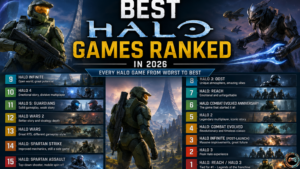
Very few franchises survive this long while still making people genuinely emotional about campaign missions, multiplayer maps, and soundtrack cues. Even fewer keep attracting new PC gamers more than twenty years later. Yet here we are in 2026, still debating the best Halo game like the series never left.
And honestly? There’s a reason for that.
Halo never relied on one thing alone. Some entries delivered unforgettable sci-fi storytelling. Others perfected competitive multiplayer. A few changed the FPS genre entirely. Even the weaker games usually had one mechanic or idea that players still talk about today.
Quick Answer
If you want the short version, Halo 3 is still the game most players consider the best Halo game overall because it nailed campaign pacing, online matchmaking, Forge Mode, cooperative gameplay, and multiplayer replayability all at once.
For story-focused players, though, Halo: Reach probably delivers the best Halo campaign thanks to its emotional finale, grounded war narrative, and unforgettable Noble Team moments.
New players starting in 2026 should begin with either Halo Infinite or the Master Chief Collection.
That’s the real answer most ranking articles skip.
How We Ranked the Halo Games
Not every Halo game tries to accomplish the same thing. Ranking them fairly means looking at more than graphics or Metacritic scores.
I replayed most of these recently through Game Pass on PC and Xbox Series X, and one thing stood out immediately: older Halo games still feel shockingly modern because of encounter design. Bungie especially understood how to create combat spaces where enemy AI reacted dynamically instead of simply rushing the player.
Modern shooters still struggle with that.
Campaign Quality and Storytelling
A Halo campaign lives or dies by pacing.
Quiet exploration matters just as much as massive tank missions or alien invasion battles. Games with memorable character arcs, cinematic presentation, environmental storytelling, and strong mission variety naturally ranked higher.
That’s why Reach, Halo 2, and ODST still hold up so well.
Multiplayer Experience
This category mattered heavily because Halo practically built Xbox Live culture.
Custom games, Team Slayer, online matchmaking, Forge creativity, skill-based arena combat, split-screen sessions, and replayability all shaped these rankings.
A weak multiplayer suite instantly dragged games down.
Innovation and Franchise Impact
Some Halo entries changed gaming permanently.
Halo: Combat Evolved helped standardize modern console FPS controls. Halo 2 transformed online console gaming years before PlayStation properly caught up.
Influence matters.
Community Reception and Longevity
Launch hype means nothing if players abandon the game six months later.
Halo Infinite is the perfect example. The launch reception was messy. The post-launch version is dramatically better. So much better, honestly, that separating the two experiences feels fair.
Every Halo Game Ranked From Worst to Best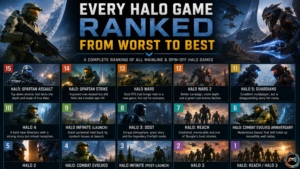
#15 Halo: Spartan Assault
Halo: Spartan Assault never felt like a full Halo experience.
That sounds harsh, but longtime fans expected large-scale futuristic combat, vehicle sandbox chaos, and cinematic storytelling. Instead, Spartan Assault delivered a smaller top-down shooter focused mostly on mobile-style mission structure.
What Worked
- Decent twin stick gunplay
- Expanded UNSC lore
- Short portable sessions
Why It Struggled
Nothing about it captured the feeling of being inside a real Halo battlefield. Covenant encounters lacked intensity. Exploration disappeared. Emotional storytelling barely existed.
You finish it and immediately forget most missions.
That’s never true for the great Halo games.
#14 Halo: Spartan Strike
Halo: Spartan Strike improved movement, pacing, and combat flow over Spartan Assault.
Still, it suffered from the same problem.
It didn’t feel essential.
The campaign lacked the atmosphere players expect from a military science fiction epic. Compare this game to ODST wandering through rainy New Mombasa streets while the soundtrack quietly hums in the background. One experience stays with you. The other feels disposable.
#13 Halo Wars
RTS fans will probably hate this placement.
I get it.
Halo Wars actually handled real-time strategy surprisingly well on Xbox 360. Ensemble Studios simplified controls intelligently, and large-scale Covenant warfare looked fantastic at the time.
Best Features
- Strong world-building
- Excellent orchestral score
- Memorable UNSC vehicle combat
- Surprisingly good cinematic cutscenes
But Halo works best when you feel physically inside the battlefield.
Watching Marines fight from above just doesn’t hit the same way as driving a Warthog through chaos while Sergeant Johnson screams over comms.
#12 Halo Wars 2
Halo Wars 2 introduced one of the franchise’s best modern villains: Atriox.
That alone boosted the game massively.
Unlike the Didact or some of the weaker Promethean-focused storytelling from 343 Industries, Atriox immediately felt dangerous. Intelligent too. He wasn’t evil because the script said so. He felt like a genuine military threat.
The Banished faction eventually became one of Halo Infinite’s strongest elements because of this game.
#11 Halo 5: Guardians
This ranking will upset somebody no matter where Halo 5 lands.
Gameplay-wise? It’s excellent.
Story-wise? It’s a mess.
Halo 5: Guardians introduced fluid movement systems, sharp gunplay mechanics, and genuinely competitive multiplayer. Arena matches still feel fast and skillful today.
Then the campaign sidelines Master Chief for large chunks of the story and pushes Fireteam Osiris instead.
That decision never recovered with fans.
One thing many modern reviews of Halo games ignore is how important emotional attachment is to this franchise. Players grew up with John 117, Cortana, Arbiter, and the original Bungie era tone. Halo 5 drifted too far from that identity.
#10 Halo 4
Years later, Halo 4 honestly deserves more respect.
Halo 4 focused heavily on character development instead of pure spectacle. Some players hated that shift at launch because multiplayer borrowed ideas from Call of Duty progression systems.
Campaign-wise, though? It worked better than people remember.
Cortana’s rampancy storyline added emotional weight rarely seen in FPS campaigns at the time. Chief stopped feeling like a silent action figure and finally started feeling human.
The Didact still isn’t a great villain, unfortunately.
#9 Halo Infinite
At release, Halo Infinite felt unfinished.
No way around it.
Missing playlists, weak progression systems, delayed Forge support, and live service confusion damaged player trust almost immediately. Steam numbers dropped fast.
Then something interesting happened.
343 Industries kept improving the game quietly.
Why Halo Infinite Feels Better in 2026
- Forge creators built incredible custom experiences
- Grappling hook combat changed sandbox gameplay completely
- Open-world exploration became more rewarding
- Multiplayer customization improved dramatically
The movement system alone deserves praise. Sliding into a grappleshot hijack during a Banished firefight feels incredible every single time.
That mechanic genuinely modernized Halo combat without destroying its identity.
#8 Halo 3: ODST
This is where the rankings become difficult.
Some fans genuinely believe Halo 3: ODST is the best Halo game Bungie ever made.
I understand why.
ODST stripped away Spartan power fantasy and replaced it with vulnerability. You aren’t an unstoppable supersoldier anymore. You’re just another soldier wandering through abandoned streets after a planetary invasion.
The atmosphere carries everything.
Rain hits the pavement. Neon signs flicker. The jazz-inspired soundtrack drifts quietly through empty streets while Superintendent Vergil clues you into what happened.
Nothing else in Halo feels like that.
The entire Halo 3 vs Halo 3 ODST debate really comes down to preference. Halo 3 feels heroic. ODST feels lonely.
#7 Halo: Reach
Reach hurts.
That’s probably the simplest way to describe it.
Halo: Reach opens with players already knowing the ending. Reach falls. Humanity loses. Noble Team doesn’t survive.
Yet the game still somehow makes you hope things turn out differently.
Why Reach Still Hits So Hard
Every squad member feels distinct. Jorge, Kat, Carter, Emile. Their deaths aren’t treated like cheap shock moments either. Bungie lets scenes breathe.
One tiny detail most ranking lists miss: Reach deliberately slows mission pacing before major tragedies. Quiet downtime makes losses feel personal.
That’s smart storytelling.
Also, the final mission remains one of gaming’s best endings.
No victory speech. No miracle rescue.
Just survival for as long as possible.
#6 Halo: Combat Evolved Anniversary
The original formula still works beautifully.
Halo: Combat Evolved Anniversary reminds you how revolutionary Combat Evolved truly was back in 2001.
Enemy AI changed everything.
Elite warriors dodge grenades intelligently. Grunt enemies panic when leaders die. Hunters force tactical movement. Combat encounters become dynamic instead of scripted shooting galleries.
That design philosophy influenced almost every major console FPS afterward.
Even now, some modern shooters feel less reactive than Combat Evolved did twenty-five years ago.
#5 Halo 2
Halo 2 changed online gaming forever.
That sounds dramatic until you remember what multiplayer looked like before Xbox Live exploded. Ranked playlists, party systems, matchmaking filters, stat tracking. Halo 2 normalized all of it for console players.
And the campaign?
Still fantastic.
Playing as Arbiter expanded Halo lore massively. Suddenly, the Covenant stopped feeling like faceless aliens and became a fractured religious empire collapsing from internal conflict.
That narrative shift elevated Halo from a simple sci-fi shooter into full-scale science fiction mythology.
#4 Halo: Combat Evolved
Some older games age badly.
Combat Evolved somehow didn’t.
The level design still feels incredible because every combat arena encourages experimentation. Plasma weapons shred shields. Human weapons finish enemies cleanly. Vehicles create unpredictable sandbox moments constantly.
Then the Flood appears.
I still remember playing 343 Guilty Spark late at night as a kid and realizing Halo suddenly transformed into survival horror without warning. Few FPS campaigns shift tone that confidently.
#3 Halo Infinite (Modern Version)
Separating modern Infinite from launch Infinite feels fair because they barely resemble the same game anymore.
Forge mode completely changed community perception.
Custom maps now recreate everything from classic Halo arenas to bizarre social spaces that look closer to Garry’s Mod experiments than traditional multiplayer maps.
343 finally leaned into Halo’s sandbox creativity instead of fighting against it.
That decision saved the game.
#2 Halo 3
If you experienced Halo 3 during the Xbox 360 era, you probably already know why it ranks this high.
This wasn’t just a game. It was basically a social network disguised as a shooter.
People spent entire weekends inside Forge maps and custom lobbies. Infection became school lunch conversation material. Split-screen sessions lasted until sunrise.
Why Halo 3 Still Works
- Near-perfect multiplayer pacing
- Incredible Forge creativity
- Strong cooperative campaign
- Legendary soundtrack
- Massive replay value
Nothing matched the feeling of loading into Valhalla with friends after school.
Honestly, nothing still does.
#1 Halo Reach / Halo 3
I tried separating them.
Couldn’t do it.
Reach delivers the franchise’s emotional peak. Halo 3 delivers its multiplayer peak. Depending on what you value most, either game can reasonably claim the title of best Halo game.
And that’s why this debate still exists in 2026.
No single Halo entry mastered everything equally.
But these two came closest.
Which Halo Game Has the Best Campaign?
| Category | Winner | Why |
| Best Story Overall | Halo 2 | Arbiter storyline transformed Halo lore |
| Most Emotional Campaign | Halo Reach | Noble Team’s final stand still hits hard |
| Best Co op Campaign | Halo 3 | Excellent pacing and mission variety |
| Best Campaign For Beginners | Halo Infinite | Modern controls and smoother onboarding |
For players asking what order to play Halo games, the release order still works best because you experience the franchise evolution naturally.
Is Halo Still Worth Playing in 2026?
Absolutely.
The Master Chief Collection alone gives PC gamers and Xbox players absurd value. You’re getting decades of FPS history in one package with remastered visuals, cooperative gameplay, Forge support, and multiplayer playlists still active today.
More importantly, Halo still feels different from modern shooters.
Combat encounters breathe more. Enemy factions behave intelligently. Vehicle combat creates unpredictable chaos constantly. Music matters. Atmosphere matters.
Modern FPS games often chase speed.
Halo understands pacing.
That’s why people still care about the best Halo games ranked decades later.
Frequently Asked Questions
What is the best Halo game of all time?
Most longtime fans still choose Halo 3 or Halo Reach.
Which Halo game has the best story?
Halo Reach usually wins because of its emotional storytelling and war narrative.
Which Halo game has the best multiplayer?
Halo 3 remains the gold standard for classic arena shooters.
Is Halo Infinite better now?
Yes. The post-launch improvements genuinely transformed the experience.
Which Halo game should beginners start with?
Halo Infinite or Combat Evolved Anniversary are the easiest entry points.
What is the best Halo campaign for co op?
Halo 3 still delivers the strongest cooperative pacing and mission structure.